How Lithuanian Kids Learn to Love Every Bite — And What American Parents Can Steal From That Playbook

Photo by Photo by Europeana on Unsplash on Unsplash
There's a moment every American parent knows too well. You've spent forty-five minutes making a real dinner — something with vegetables, something with actual flavor — and your kid takes one look at the plate and announces they only eat plain pasta now. It's exhausting. It feels personal. And somehow, it's become so normalized that we've built an entire industry of chicken nugget alternatives around it.
But spend a little time in a Lithuanian-American household, and that dynamic looks almost foreign.
"My kids eat pickled cucumbers as a snack," says Rasa Balčiūnienė, who moved from Vilnius to Chicago twelve years ago and is raising two kids, ages seven and ten, with her husband Tomas. "Not because I forced them. Because that's just what's on the table. It was never a negotiation."
She laughs when she hears about American parents making separate meals for their children. "In Lithuania, the idea that a child would get a different dinner than the adults — it just doesn't really exist. You eat what's there. And you grow to love it."
The Table Is Not a Restaurant
This is probably the single biggest philosophical difference between how Lithuanian families and many American families approach mealtime. In traditional Lithuanian households — and in the kitchens of Lithuanian-American families who've held onto these habits — there is one meal. Full stop. Mama makes šaltibarščiai (that gorgeous cold beet soup), and everyone eats šaltibarščiai. There's no backup grilled cheese waiting in the wings.
This isn't harshness. It's actually a form of respect — for the cook, for the food, and for the child's ability to adapt. Lithuanian parents tend to trust that kids are more capable than we give them credit for. A child who is genuinely hungry will eat what's in front of them. And over time, what's in front of them becomes familiar. Familiar becomes comfortable. Comfortable becomes loved.
Rūta Kazlauskienė, a Lithuanian-American mother of three in Minneapolis, puts it simply: "We didn't have the word 'picky' in our house growing up. My mother would have found that very strange. You just ate. And now I cook the same way for my own kids."
Flavor Starts Early — Like, Really Early
Another piece of the puzzle is exposure timing. Lithuanian food culture doesn't believe in a "bland baby food" phase that stretches on indefinitely. Kids are introduced to real flavors — sour, fermented, smoky, earthy — at a remarkably young age, and those early exposures do serious neurological work.
Food researchers have known for a while that repeated exposure is the key to acceptance. Kids typically need to encounter a new food anywhere from eight to fifteen times before they'll willingly eat it. Lithuanian food culture essentially automates this process. When fermented vegetables show up on the table three times a week because that's just how the kitchen runs, children rack up those exposure points without anyone making a big deal of it.
"My daughter had a little sauerkraut on her plate from the time she was old enough to try solid foods," says Rasa. "She didn't love it at first. But it was always just there. Now she asks for it."
This is a far cry from the common American approach of hiding vegetables in smoothies or disguising broccoli in mac and cheese. Lithuanian food culture doesn't hide anything. The sour is sour. The beet is a beet. And kids learn to meet those flavors honestly.
Eating Together Is Non-Negotiable
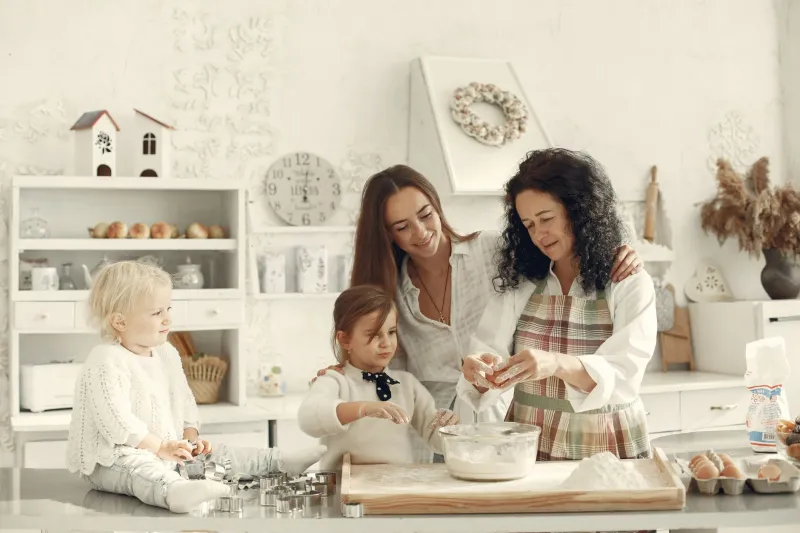
Family meals in Lithuanian tradition aren't a wellness trend or a scheduling achievement — they're just what dinner is. The table is where the family gathers, where the day gets processed, where food is passed around and commented on and enjoyed communally.
That shared context matters more than most of us realize. When a child watches adults eat something with obvious pleasure — when Dad loads up his plate with herring in cream sauce and Mom reaches for seconds of the beet salad — the implicit message is that this food is good. Worth eating. Desirable, even. Kids are wired to imitate the adults around them, and nowhere is that more powerful than at the dinner table.
Contrast that with a household where adults eat one thing and kids eat another, where vegetables are presented as a punishment to be endured before dessert, and you start to see how the messaging gets muddled fast.
What American Families Can Actually Do
You don't have to overhaul your entire kitchen to borrow from this playbook. Here are a few practical shifts that Lithuanian-American parents swear by:
One meal, served family style. Put everything in the middle of the table and let people serve themselves. Kids feel more in control when they can choose their own portions, but the food on offer is still what you made — not a separate kid-friendly alternative.
Don't announce the ingredients. This sounds almost too simple, but it works. Don't walk into dinner saying "okay, tonight we're trying something new and different." Just put it on the table. The less fanfare, the less anxiety.
Let sourness and fermentation into the rotation early. A small dish of pickles alongside dinner, a spoonful of sauerkraut next to the pork chop, a little dark rye with butter — these additions cost you almost nothing, and they quietly expand your kid's palate one meal at a time.
Eat with visible enthusiasm. If you're grimacing your way through dinner, your kids notice. If you're genuinely enjoying what's on the table — talking about the flavors, going back for more — they notice that too.
Patience over pressure. Lithuanian parents aren't white-knuckling it through dinner, forcing every bite. The expectation is simply consistent, low-drama exposure. No reward systems, no bribing with dessert. Just food, on the table, every night.
The Bigger Picture
There's something quietly radical about the Lithuanian approach to feeding children, and it has nothing to do with any particular recipe. It's a fundamental assumption that kids are capable — capable of handling real flavors, capable of eating what adults eat, capable of learning to love a wide and varied table.
American food culture has spent decades lowering those expectations, creating a parallel children's menu that prioritizes beige, bland, and familiar at every turn. The result is a generation of adults who have to "learn" to eat vegetables as a conscious adult project, complete with recipe blogs and meal plans and a lot of emotional baggage.
Lithuanian grandmothers didn't have any of that. They just cooked one pot of something good and called everyone to the table.
Maybe that's still the best strategy we've got.